How patients consent to receive text messages from Verity
Verity Health provides patient engagement software to behavioral health treatment providers. When a patient receives a text message from a Verity-supported provider, that message is sent on the provider's behalf — and only after the patient has affirmatively consented to receive SMS communications related to their care. This page documents how that consent is collected, what patients are told, and how patients can opt out at any time.
Overview
Patients enroll in SMS communications through one of two paths. In both paths, consent is affirmative, separately captured (not bundled into a general terms acceptance), and can be revoked by the patient at any time by replying STOP to any message.
Provider intake
The patient signs a consent form during admission or intake at the treatment provider's facility — paper or electronic — that explicitly authorizes SMS communication for appointment confirmations and care-related messages.
Verity patient app
The patient creates an account in the Verity patient app and signs a digital consent form before notifications are enabled, with full disclosure of message frequency and rate language.
Verity acts on the provider's behalf under a signed Business Associate Agreement (BAA), and where the provider is a federally assisted substance use disorder program, under a Qualified Service Organization Agreement (QSOA) consistent with 42 CFR Part 2.
Path 1: Provider intake consent
Each Verity-supported clinic uses its own admission consent packet. Wording varies by provider, but every packet includes a clearly labeled SMS authorization that the patient must initial or sign separately from other consents. The authorization covers appointment-related communications and broader care-engagement messaging — including survey participation, follow-up, treatment-program notifications, and contingency management messaging tied to the patient's care plan. Below is the SMS authorization section from the General Consent for Admission packet used by one of our partner clinics, High Point & Affiliated Organizations:

Excerpt: "Authorization to Receive E-Mail and/or SMS Communication from HPAO" — High Point & Affiliated Organizations, General Consent for Admission, Form (ATCH) 400-710-019, page 3 of 3. The patient initials and signs this section separately at admission. Reproduced with permission.
HPAO may utilize electronic communications to provide information regarding appointment confirmation or requests for survey participation. I understand that I may receive email communication, when provided on admission, or SMS texts from my providers to confirm appointments scheduled. Verbatim text · High Point & Affiliated Organizations Form 400-710-019
The same packet includes a separate Consent to Follow-Up that authorizes additional care-engagement communications, including post-discharge follow-up and information regarding alumni and program participation. Together, these consents authorize the full range of care-related SMS messaging Verity delivers on the provider's behalf. The signed packet is retained in the clinic's electronic health record system. A redacted sample of the full multi-page consent packet is available for review on request: info@verityhealth.io.
Path 2: In-app digital consent
Patients who enroll directly through the Verity patient app complete a digital consent flow before any SMS notifications are sent. The flow requires the patient to read each consent, sign with a finger-drawn or typed signature, and confirm. Identity is verified via a government-issued photo ID upload.
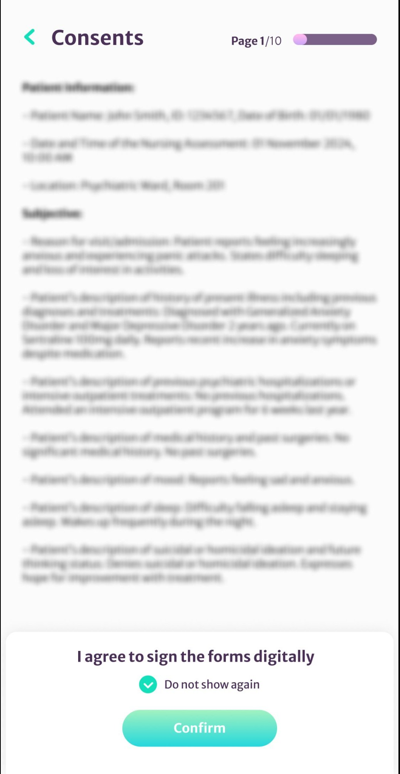

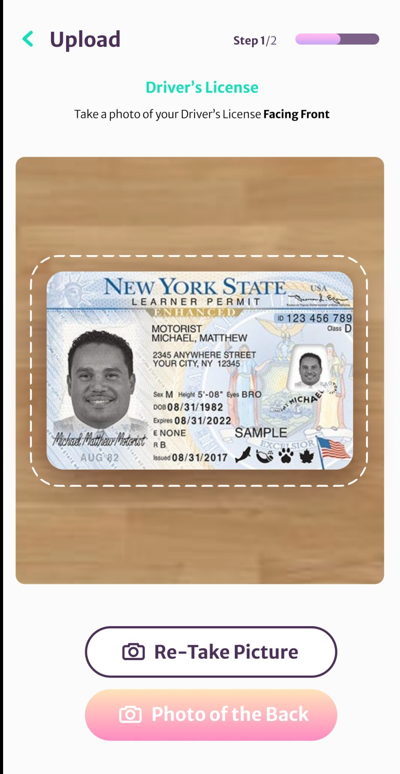

The opt-in checkbox is unchecked by default. Patients are not pre-enrolled. Consent is logged with a timestamp, the patient identifier, and a copy of the exact consent text presented at the time of signing.
Required disclosures presented to patients
The following disclosures are presented at every opt-in point — on intake forms, in the app consent flow, and in the welcome confirmation message:
- Program name
- Verity Health care & appointment communications
- Message types
- Appointment reminders, check-in requests, confirmations, care-engagement messages (including treatment-related notifications, points and rewards earned for completing care actions, program updates, and follow-up), and care-related auto-replies
- Message frequency
- Message frequency varies, typically 1–5 messages per week per patient
- Carrier rates
- Message and data rates may apply
- Help
- Reply HELP at any time for support, or contact your treatment provider directly
- Opt-out
- Reply STOP at any time to unsubscribe. No further messages will be sent.
- Privacy
- Mobile numbers and opt-in data are never shared with third parties for marketing purposes. See Privacy Policy.
Representative messages
Patients who consent receive messages of the following types. All messages identify the treatment provider and include opt-out instructions where applicable.
Note on points and rewards messages
Point-based confirmation messages are part of a care-engagement and contingency management program — an evidence-based clinical intervention used in behavioral health treatment to reinforce treatment adherence and engagement. Patients consent to these messages as part of their care plan during intake or in-app enrollment. Points messages are auto-replies tied 1:1 to specific care actions (such as confirming an appointment); they are not promotional messages and are not sent independently of a triggering care event.
Opting out
Patients can stop receiving SMS messages from Verity at any time by:
- Replying STOP to any message — opt-out is processed immediately and no further messages are sent;
- Disabling SMS notifications in the Verity patient app under Account Settings;
- Contacting their treatment provider and requesting that SMS communications be discontinued; or
- Emailing info@verityhealth.io.
Opt-out does not affect the patient's care or treatment in any way.
Legal & compliance
Verity Medical, Inc. (operating as Verity Health) operates this SMS program in compliance with the Telephone Consumer Protection Act (TCPA), the CTIA Messaging Principles and Best Practices, HIPAA, and 42 CFR Part 2 where applicable. Verity executes a Business Associate Agreement (BAA) with every provider customer and, where required, a Qualified Service Organization Agreement (QSOA). Patient consent is obtained by the treatment provider and relied upon by Verity to send messages on the provider's behalf.
For questions about this program, including reviewer or carrier requests for additional consent documentation, contact info@verityhealth.io.